




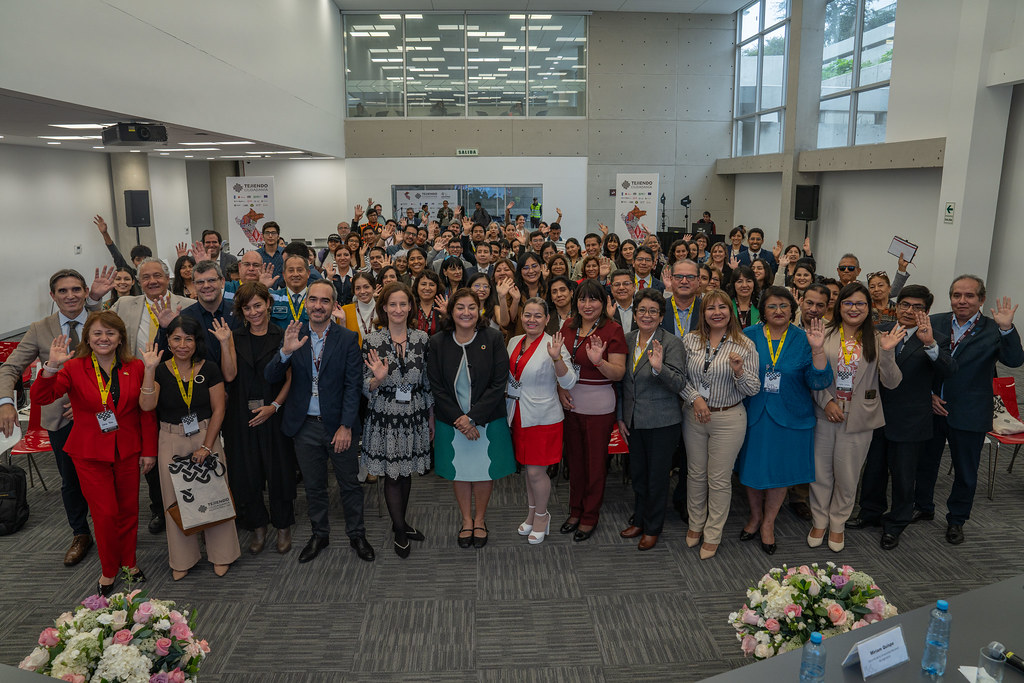
For two days, members of the public and private sectors, civil society and academia debated the main challenges facing the central macro-region.
The fourth macro-regional meeting of ‘Tejiendo Ciudadanía’, organized by the United Nations Development Program (UNDP), Grupo La República, the Institute of Peruvian Studies (IEP) and the Peruvian Scientific Network, with funding from the European Union, was held in Lima. The event brought together more than 200 representatives of indigenous communities, the public and private sectors and civil society, as well as participants from nine universities in the center of the country.
Bettina Woll, UNDP representative, pointed out that during the last year and a half “the Tejiendo Ciudadanía initiative gathered diverse perspectives, including those of the youth, on the country’s most relevant challenges and proposals on how to face them. This participatory and decentralized process, which has highlighted the importance of listening to all voices, has invited us to continue trusting and connecting to act together for Peru.”
CRIME AND IMPUNITY: A VICIOUS CIRCLE THAT STRIKES A BLOW TO DEMOCRACY
Extortion has become routine. So far in 2025 alone, more than fifteen drivers have been murdered in Peru, and in the last two years, more than 7,600 bodegas have had to close their doors across the country. But beyond the numbers, the phenomenon goes deeper: organized crime not only sows fear, it also strikes at democracy and erodes confidence in the rule of law.
During the meeting “Tejiendo Ciudadanía”, associations, specialists and authorities addressed the consequences of organized crime and its most persistent correlate: impunity. What emerged from this dialogue was a complex picture of the country, in which the advance of crime is not only measured by the number of victims, but also by its capacity to neutralize institutions, co-opt power and demobilize citizens.
For Luis Villanueva, president of the General Confederation of Peruvian Workers (CGTP), the impact is not only economic: “Union leaders can no longer unionize as they did 20 years ago, because criminal gangs are on the prowl,” he warned. In 2025, 26 workers have already been murdered in the civil construction sector.
For its part, the Judiciary acknowledged that its capacity for action is seriously limited. Jhony Contreras, president of the Supreme Court, emphasized the political pressures faced by his institution. “The political power is trying to impose itself on the work of the judiciary. Our independence is threatened from the moment we depend on another branch of government for our budget. We cannot even increase the number of judges,” he lamented.
For Carlos Basombrío, former Minister of the Interior, the problem is structural and he proposed a multi-sectorial response. “There cannot be a divorce between the Police, the Judiciary and the penitentiary system. If there is no coordination between these institutions, there is no justice, and without justice there is no democracy”.
POLITICAL REPRESENTATION AND INFILTRATION OF ILLEGAL ECONOMIES
Tarcila Rivera Zea, president of the Center of Indigenous Cultures of Peru (CHIRAPAQ), a defender of the rights of indigenous peoples, made a strong criticism of the current democratic model. She regretted that indigenous peoples are only included at election time. She also denounced that, without effective political participation in their territories, indigenous communities are left unprotected against illicit economies such as drug traffickers, land traffickers and illegal miners.
From a territorial perspective, the vice-governor of Pasco, Doris Guillermo, and Violeta Bermúdez, former president of the Council of Ministers, called for a rethinking of the decentralization process: “We have regional governments that, when there is a crisis, look to the national government. It is essential to position the State in the territories”, said Bermúdez.
“There is a need for greater autonomy for the regions, so as not to depend on the central government, as in the case of illegal mining, where we need the Ministry of Energy. If our management at the regional level had greater competencies, oversight could be more effective,” asserted Doris Guillermo.
In addition, Bermudez also proposed an urgent reform of the National Police, highlighting the high levels of corruption in its ranks. For her, the response to crime cannot only be police, but also structural, political and ethical.
For the deputy mayor of Nazca, Milagros Salazar, regional diversity must be considered. “Not all illegal economies affect each territory in the same way. We need differentiated and articulated solutions with local authorities”.
PRODUCTIVITY TO REDUCE INFORMALITY
In a country where more than 70% of workers work in the informal sector, thinking about economic growth without addressing this issue seems nonsense. Diego Macera, economist and former director of the Peruvian Institute of Economics (IPE), warns: “Formality is important because it leads to productivity. It is not only about complying with rules, but also about generating decent employment, linking up with suppliers and allowing small businesses to grow in a sustainable way,” he said.
But getting formalized is not easy: “We can’t go throwing RUCs all over Peru and say that we are a formal country,” Macera ironizes. There are complex barriers: sector permits, cumbersome paperwork and an unfriendly tax system. In addition, extra salary costs complicate hiring “As people generate more money, they also have to pay more. That makes many of them choose informality”.
Along the same lines, César Manuel Quispe, Vice Minister of MSMEs and Industry, acknowledged the structural challenges faced by entrepreneurs in Peru. “We live in a culture of distrust. Formalizing is still a path full of obstacles and bureaucracy,” he explained. He announced the promotion of a single labor window and a national formalization policy that connects MYPES with value chains and reliable suppliers. “The transition to formality is not only an ideal, it is a necessity to raise productivity and guarantee rights,” he emphasized.
For the mayor of Chancay, Juan Álvarez, there could be opportunities for formal development if there were orderly planning. The Chancay mega-port brings technology “but it is not adequate to the demands of our population”. Elena Ríos, president of the Chamber of Commerce, Industry and Tourism of Áncash, questioned “What is the use of having mega projects if there is no investment in the city that receives them? Likewise, Ríos warned about the lack of technical and university training to prepare young people to integrate into the new port economy.
RESILIENT INFRASTRUCTURE FOR DISASTER RISK MANAGEMENT
Rolando Capucho, head of the National Center for Disaster Risk Estimation, Prevention and Reduction (CENEPRED), made it clear that it is not possible to talk about development if disaster prevention is not taken into account, since disasters can not only cause damage to the infrastructure of cities, but also take the lives of people.
In this line, he stated that they carry out disaster risk prevention work in all regions, but that the execution of their plans depends on regional and sub-national governments, which do not always prioritize disaster prevention in their management.
“The municipalities and regional governments are the ones who have to take responsibility and take timely measures. Prevention is a task that corresponds to the three levels of government,” he said.
On the other hand, Freddy Marrero, director of the Research Institute of Engineering Sciences of the National University of Huancavelica said that it is necessary to “start providing infrastructure in health, education, connectivity, electricity, among others”, but for this, it is urgent to change the approach”.
Juan Pacheco, general manager of the Association for the Promotion of National Infrastructure, emphasized that “it is not the same to carry out a project in Lima as in Iquitos or Piura. Planning must be territorial. The public budget alone is not enough. Private investment and the commitment of the State are required”.
Miriam Quispe, professor at UNI, concludes: “There is a lack of strategies to raise awareness in society. At UNI we are updating our educational model to incorporate sustainability. Education must also join this challenge”.
Peru cannot grow if it does not formalize, if it does not invest in basic infrastructure, if it does not regain the confidence of those who risk to undertake. But above all, it will not be able to grow if it does not build a country where citizens have the tools to participate, decide and demand.
MAIN PROPOSALS: